
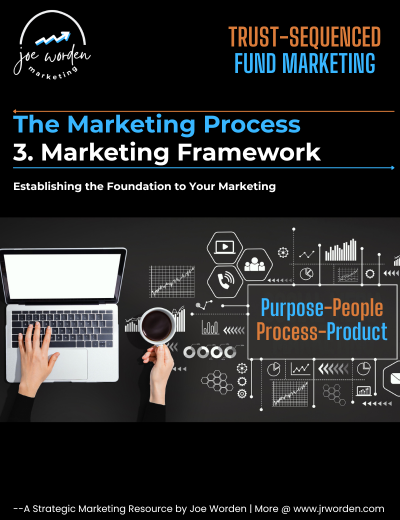
Most managers still operate with polished but disconnected assets—decks, emails, web pages, and events that look fine in isolation but fail to add up to a coherent story investors can follow. This paper introduces a process for building a marketing framework organized around Purpose, People, Process, Product—a sequence that turns scattered efforts into a single operating system every message, touchpoint, and campaign must serve.
The objective is strategic coherence: a structure that keeps your marketing aligned as markets shift, teams grow, and campaigns multiply, so you are no longer throwing good collateral at a broken system. :contentReference[oaicite:1]{index=1}
The Purpose People Process Product framework starts by clarifying Purpose and People before anyone writes a line of copy or designs a slide. Purpose becomes the emotional anchor that differentiates you from the hundreds of managers all claiming superior returns, while People connects your team story to the specific investors you are best equipped to serve.
That combination creates a stronger messaging architecture, sharper positioning, and less internal debate about what to say, who to say it to, and why anyone should care. :contentReference[oaicite:2]{index=2}
The framework then defines Process and Product as trust-building components rather than sales scripts. Process maps the stages and content that move investors from awareness to commitment, while Product is presented as the logical outcome of credibility and fit already established in the earlier stages.
This prevents premature pitching, improves narrative sequencing across channels, and helps ensure your offering feels like the natural answer to a well-defined problem rather than a product looking for justification. :contentReference[oaicite:3]{index=3}
This is not abstract theory. It is a strategic fund marketing framework built for real-world decisions—what to build, what to prioritize, what to hold back, and how to keep the full system aligned.
A behavioral finance layer shows how each part of the structure can address the biases and committee dynamics that shape allocator decisions. Instead of hoping good content is enough, the framework helps calibrate proof, pacing, and emphasis to investor constraints, motivations, and governance realities.
The result is marketing that feels more naturally aligned with how sophisticated people evaluate new managers, reducing friction and increasing confidence as prospects move deeper into due diligence and System 2 thinking. :contentReference[oaicite:4]{index=4}
Once this 4P marketing framework is in place, it becomes the reference point for every future campaign, raise, and materials refresh. It keeps differentiation and messaging fit consistent even as conditions change, and it allows internal decisions to be made from structure instead of opinion.
That is why this process becomes more than a tactic. It becomes the foundation that makes every downstream element of trust-sequenced marketing work harder, with greater consistency and less waste. :contentReference[oaicite:5]{index=5}
